
Yeonggil Choi, Head Sommelier
최종 수정일: 9월 17일
Solbam’s Head Sommelier, Yeonggil Choi, leads the restaurant’s wine team with greater strength and balance, placing the greatest value on understanding what guests truly want and what kind of time they hope to spend at the restaurant.

What first led you to the path of becoming a sommelier?
I majored in tourism at university and began my first professional career at a hotel. I didn’t start out with the clear intention of becoming a sommelier, but as I continued working in hospitality, I began wondering how I could develop greater expertise and grow within the service industry. That was when I became interested in the role of a sommelier, a profession that specializes in wine.
After leaving the hotel, I began my career in restaurants. The first restaurant I worked at did not have a professional sommelier. As I served guests, I developed a stronger desire to study wine more seriously. I thought that if I could build more specialized knowledge, I would be able to create better experiences for guests.
I had a vague desire to work at a Michelin-starred fine dining restaurant, so I interviewed at several places and eventually began working at “Impression,” which had been awarded two Michelin stars. I started as the most junior member of the floor team and later became a captain, gaining practical experience in wine service and handling. After that, when the chef and team moved to Restaurant Allen, I continued working with them. I spent nearly two years there, and later worked for about a year and a half at Perigee, a restaurant specializing in pasta.

You have experienced a wide range of venues, from brunch cafés and fine dining restaurants to bistros.
Wine can shine in many different settings, and I was curious about many things. Even when I moved from a Michelin-starred restaurant to a bistro after two years, I saw it as a new challenge.
At the time, I was influenced a lot by the paths taken by my seniors. Some sommeliers moved from fine dining restaurants to corporate roles, some opened their own wine bars, and others experimented with more casual bistronomy-style venues.
I was impressed by the fact that great sommeliers could meet wonderful guests and enjoy their work even outside the fine dining world. The spaces and experiences that guests love are not limited to fine dining. I became interested in the role of using professional knowledge and a deep understanding of wine to make guests’ experiences even better in a more casual setting.
After gaining meaningful experience at a bistro for about a year and a half, I took a short break, during which I got in touch with Sommelier Ko Dong-yeon. I felt that my perspective on the work I wanted to pursue could create synergy with Solbam, and I also connected with the chef’s vision. Working as a solo sommelier has its own appeal, but the idea of growing together as a team was also very attractive to me. That is how I joined Solbam.
What do you focus on most when building a beverage list?
I believe that the direction of the restaurant should be reflected in the wine list. It should not simply be a list of good wines. It should carry thoughts about nature and sustainability, and of course, it should pair well with the food. Understanding the stories of producers, finding the points of connection between those stories and our restaurant, and communicating them well to guests is, I believe, an important role of a sommelier.
You have spent three years at Solbam. What kinds of changes and growth have you experienced during that time?
Over the past three years at Solbam, there have been many changes and much growth, both personally and as a team. Personally, I have grown a lot in terms of service, and naturally, my knowledge of wine has deepened as well. But the biggest thing I learned was not simply knowledge about wine or service.
Working together here, I learned a great deal about relationships with wine importers, the various operational aspects that a sommelier needs to consider within a restaurant, and how to manage not only guest service but also wine programs and operations as a whole. It was a period that helped me understand more deeply that the role of a sommelier is not limited to recommending and pouring wine.
As a team, we started out quite small, but now we have four sommeliers working regularly at the restaurant. Within that team, we communicate closely to minimize mistakes as much as possible. By communication, I don’t simply mean talking a lot. I mean using the various wine programs, records, and systems we have in place to guide guests accurately and to ensure that there is no confusion within the team.

What is Solbam’s way of growing together as a team, rather than relying on one individual sommelier?
Solbam is a restaurant that places great importance on documentation. We record every process: what we are currently working on, what we are preparing, and what we need to do each month. I believe this is one of the biggest reasons Solbam has been able to grow as a team.
In many restaurants, people simply follow instructions from their superiors, and in practice, they often operate without detailed records or manuals, relying instead on individual ability and intuition. When that happens, the level of work can vary greatly depending on each person’s capacity, and it becomes difficult for the system itself to develop.
But Solbam is different. To avoid confusion among the sommeliers currently working together, we move based on records, and within that structure, we plan and carry out what we need to do. As those records accumulate, the team is able to look in the same direction. I believe that process has allowed us to develop a great deal.
You were recently promoted to Head Sommelier. What do you see as your most important role now?
Even when I was a senior sommelier, professional knowledge of wine and guest service were, of course, very important. But now that I am Head Sommelier and oversee the entire team, the area I focus on most is human resource management.
On my days off, the other sommeliers need to naturally take on the head role, and there should be no gap in service or operations. Of course, the team has always worked together with one mind to serve guests well, but this is my first time serving as Head Sommelier, so I think the first thing I need to focus on is making the team stronger.
And rather than immediately trying to express my own personal style, I think the priority is to maintain the color that Solbam has shown so far and to carry forward the direction built by the previous Head Sommelier in a stable way. Compared with other restaurants, Solbam’s sommelier team has a strong image of growing together and supporting one another as a team. I believe my role now is to maintain that strength and make it even more solid.

How is the current Solbam sommelier team structured?
Currently, I serve as Head Sommelier, and we have four sommeliers working together in total. I believe the greatest strength of our team is that guests do not feel a significant gap between the Head Sommelier and the junior sommeliers.
In some restaurants, one Head Sommelier may be very impressive and almost represent the image of the restaurant like a star. But at Solbam, rather than having one individual stand out and define the restaurant’s image, we aim to raise the overall average level and natural consistency of the sommelier team as a whole.
No matter which sommelier serves a guest, we want there to be no major difference in the technical aspects of wine service or in the level of service. I believe that is our team’s greatest strength. As the gap between individual team members narrows, we are also able to respond quickly and clearly when unexpected situations arise during service. That is one of the current strengths of Solbam’s sommelier team.
Is there a guest who remains especially memorable to you?
There are so many, but I especially remember guests who visit once every season. I met them when I first joined, then saw them again a few months later, and again the following season. With guests like that, you naturally feel happy to see them. You also become curious about how they have been doing.
Of course, warmly welcoming every guest is fundamental, but I think it is only natural to feel a particular sense of gratitude and delight toward guests who return several times. Because of the structure of fine dining, there are limits to how much extra we can do for regular guests, but I always try to convey that feeling sincerely.
How are food and beverage pairings created at Solbam?
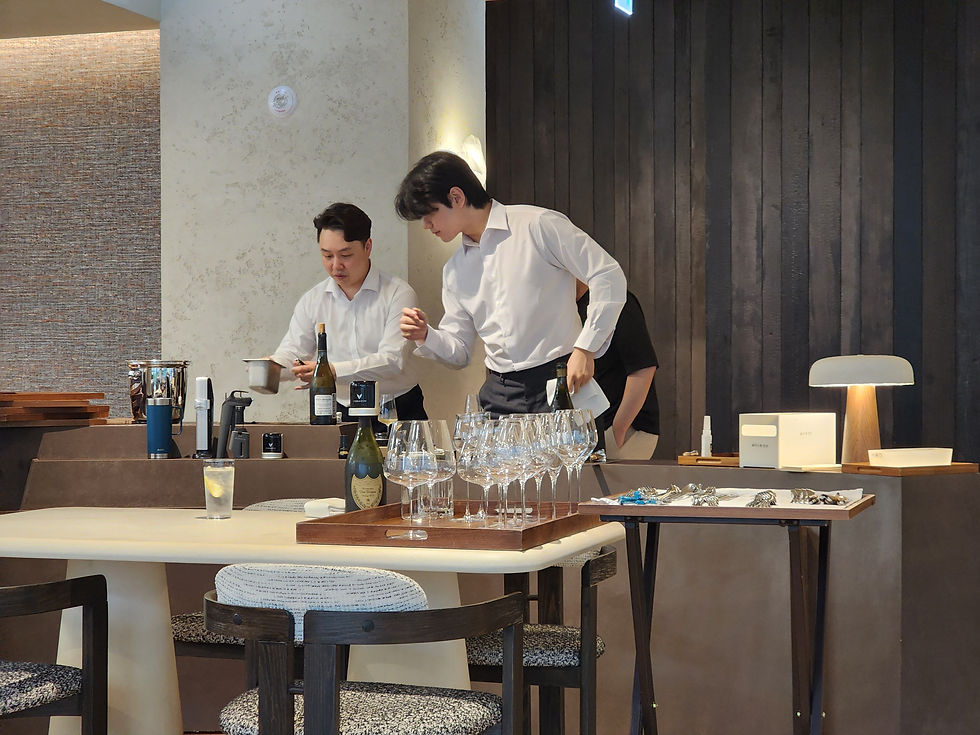
When the chef develops a new menu, the beverage team begins searching in advance for wines that might pair well with it. Since we have worked together for three years now, we can often understand the general direction of the menu, and many of the wines we prepare ahead of time end up working well. Because some importers have limited quantities, it is also important to secure good wines in advance.
When the seasonal menu is almost complete, the chef and sommelier team taste the dishes and wines together to finalize the pairings. Usually, we taste three or four wines for each dish to find the best combination. In the case of ingredients such as fish or Korean beef, the original flavor of the ingredient is very clear, so we can often create stable pairings with classic wines.
Of course, there are also pairings that are not easy. For example, we once had a pork roulade dish served with jang, and classic wines did not pair well with it because the aroma of the jang was quite strong. Unexpectedly, an Italian natural wine worked beautifully. It was not a universally easy or broadly loved wine, but when paired with the dish, the harmony of its fermented aromas was excellent. It became a new learning experience for us. The guest response was also very positive. I want to continue taking on those kinds of challenges and experiments to find better pairings.
How do you think the Solbam sommelier team should continue to develop?
First, I think it is important for us to take time to revisit our internal systems and details. We need to continuously check within the team whether there are things we are missing during service, whether the details of our wine service are being maintained consistently, and whether there are parts we have not organized properly simply because we have been busy.
Showing something new externally is also important, but right now, I think we need time to become stronger internally. I want to improve the completeness of the team by carefully reviewing our service, systems, records, and communication.

How have you developed yourself as a sommelier?
Studying is, of course, something that must continue in parallel. But to me, a good sommelier is “someone who keeps the obvious things.”
Keeping wine in its optimal condition, arranging linens neatly, and completing opening preparations perfectly. These things may seem small, but maintaining these basics is very important. Sometimes, as people gain more experience, they begin to overlook the fundamentals. But in order for us to remain a team that provides the same quality of service every day, we place the greatest importance on the basics. Our sommelier team continues to emphasize this to one another as we grow together.
How do you view the profession of a sommelier?
This is something I often say to younger team members, and it is also connected to the kind of sommelier I hope to become. I believe the most important thing is attitude.
When serving guests, there are moments when you feel pressure to present yourself perfectly as an expert in wine and service. Because of that, you may sometimes feel as though you need to pretend to know more than you actually do, even when you are not entirely sure. But I believe sincerity, honesty, and the ability to admit what you do not know should come first.
Something worse than saying “I don’t know” is making something up just to get through that moment. A sommelier is a wine professional, but fundamentally, a sommelier is also a service professional. And I believe the essence of service is communication.
Communication is about sincerely sharing and conveying warmth between people. There is no need for the pressure of “I must know more” to interfere with that. Even now, if a guest asks me something and I do not know the answer clearly, I tell them that I do not know and that I will check before getting back to them. I believe that kind of attitude is a better way to build trust and relationships with guests.

What do you think the role of a sommelier is?
A sommelier is, fundamentally, a service professional. So I think the most important thing is to help guests spend their time comfortably. Some guests want to hear stories about wine, while some tables may not consider wine to be such an important part of the meal. There is also a risk that the sommelier may end up providing service in a way that makes the sommelier feel like the main character. I think good service is about reading the guest in front of you, understanding what they want, and creating the right setting for them.
We need to understand what kind of mood the guest has arrived in, what the purpose of their meal is, and how we can care for them beyond just food and wine. Service needs consistency and rules, but I believe its completion ultimately has to be tailored to each individual guest.
For example, a guest may not mention an allergy at first, and we may only discover it during conversation and quickly change the menu. Or we may realize late that it is a special anniversary and prepare something accordingly. I believe this kind of careful observation and response is something only the service team can provide, and it is one of the ways we can elevate the value of the guest experience beyond what the kitchen alone can create.
What do you think is the most important virtue for a sommelier?
Honesty. Being a sommelier does not mean you can know every wine or create the perfect pairing for every situation. That is why the most fundamental quality for someone in service is an honest attitude.
Rather than wanting to appear like an expert in front of guests, I believe it is more important to communicate accurately and sincerely. That ultimately builds longer-lasting trust and leads to better service.

Do you have any personal goals for the rest of this year?
This year, I personally prepared for the Master Sommelier exam. Although I did not pass immediately, I see it as part of a process of growing and learning as I prepare again for next year’s exam.
Right now, rather than focusing on external activities, my goals are to prepare for next year’s exam and to review the current restaurant system in greater detail. I hope this will be a period in which I can pursue both personal growth and stable team operations.
What kind of future do you imagine for yourself in the long term?
Ever since I was younger, when I imagine myself in the future, I still see myself working as a sommelier. Like many seniors before me, I imagine myself continuing to serve guests inside a restaurant.
Of course, to continue service as I get older, I believe I must be good at it. It will only be possible if I do not stop developing professionally and continue to learn and grow. I hope to continue my path steadily as a sommelier, within restaurants and within service.


댓글